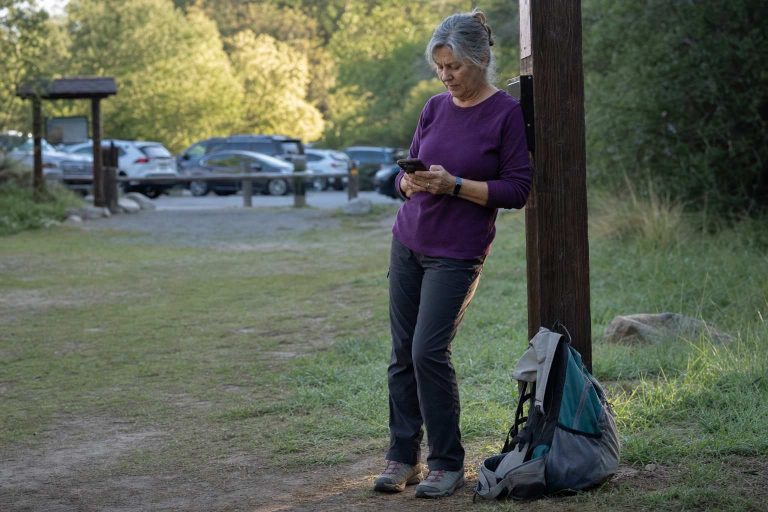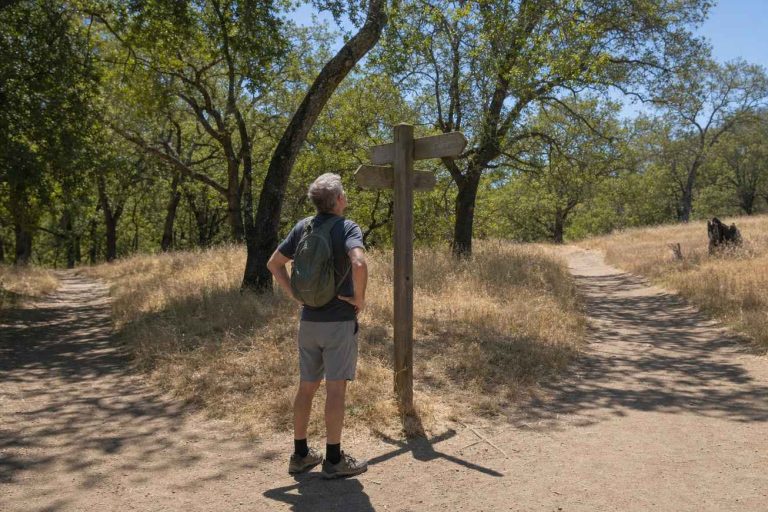
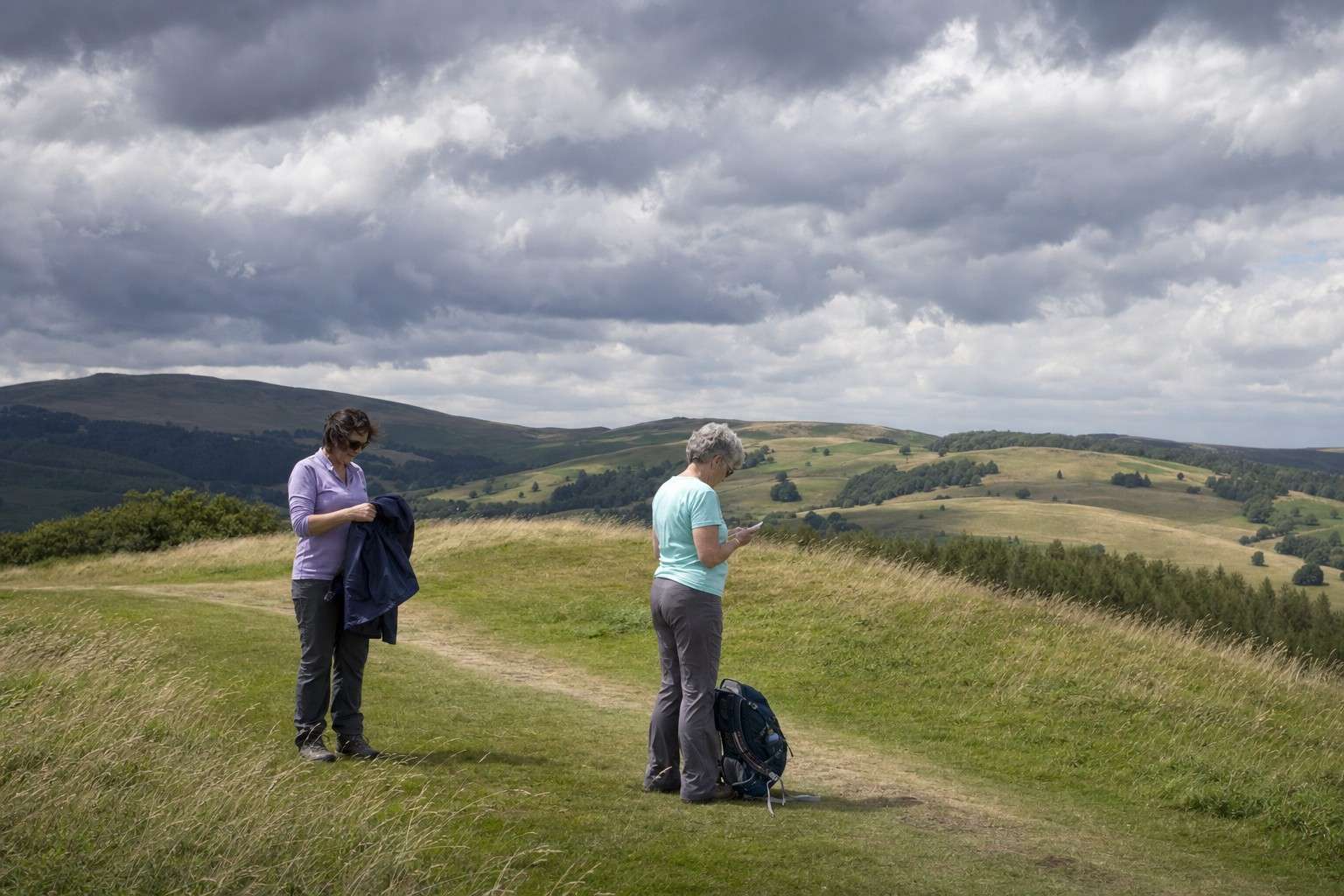
The clouds over the ridge have been building for twenty minutes. The wind has picked up, a steady push instead of the occasional gust you noticed at the trailhead. The temperature feels a few degrees cooler than when you started.
Nothing alarming yet.
But something has shifted.
This is the moment most weather surprises begin. Not a sudden storm, but a quiet accumulation of signals that the day is moving in a different direction.
Knowing how to read those signals, and what to do when they stack up, is one of the most practical skills a new hiker can develop.
The reassuring truth is that most mid-hike weather changes are manageable. The sky gives you signals.
The skill is learning to read them early enough to act with your options still open.
This article won’t cover hot-weather risks. If you’re hiking in summer heat, the advice on heat thresholds and safety rules applies there. This is about everything else: the cold, the rain, the wind, and the lightning decision.
The Five-Minute Forecast Check Before You Leave

The most useful weather preparation happens at home, not on the trail.
A current forecast matters, but a trend matters more. Check whether conditions are expected to hold steady, improve, or deteriorate over the hours you’ll be out. A 70 percent chance of afternoon thunderstorms looks different at 7 a.m. than it does on a hike you plan to start at noon.
A few things worth noting before you go:
Start and end temperatures. If the forecast shows a 15-degree drop by mid-afternoon, pack an extra layer even if the morning feels warm. Cold arrives faster on the trail than it does in town.
Wind forecast. Wind alone doesn’t stop a hike, but it changes the math on everything else. A wet jacket that would be merely uncomfortable in calm air becomes a serious heat drain in a 20 mph wind.
Afternoon storm windows. In many mountain and high-elevation areas, afternoon thunderstorms form reliably in summer.
The standard advice from rangers and experienced hikers is to be off exposed ridges and summits by noon or early afternoon.
If temperatures will exceed 85°F during your hike, reschedule.
Heat safety outweighs pushing through.
That principle applies in the other direction too. A forecast showing a strong front moving in, significant rain, or rapidly dropping temperatures is a clear signal to pick a different day. No trail is worth racing a deteriorating forecast.
What the Sky Is Actually Telling You
Weather reading is a skill that builds over time, but a few visual cues are worth knowing from the start.
Cumulus clouds that grow vertically are the most important thing to watch. Puffy white clouds that stay flat and spread out horizontally are generally stable. Clouds that build upward into tall towers with dark bases are thunderstorm candidates.
A steady darkening on the horizon in the direction you’re walking, combined with wind that has shifted to blow toward the dark area, usually means the system is moving your way.
A sudden drop in temperature in the middle of a warm day is a reliable signal that a front is passing through. If the air feels noticeably colder than it did ten minutes ago, that’s worth pausing over.
None of this requires reading a barometer or understanding meteorology. It requires paying attention to how the air feels and what the clouds are doing while you walk.
None of this requires reading a barometer or understanding meteorology. It requires paying attention to how the air feels and what the clouds are doing while you walk.
Why Mild Temperatures Can Still Be Dangerous
This is the piece of weather knowledge that surprises most beginners, and it’s worth sitting with.
A temperature of 55°F (13°C) sounds comfortable. On a dry, calm day, it is. Add rain that soaks through your base layer and a steady 20 mph wind, and the effective temperature your body experiences drops closer to 40°F (4°C) or below. Heat loss from wet skin in moving air is dramatically faster than cold alone.
The practical danger is hypothermia, and it can develop at temperatures well above freezing.
The American Hiking Society notes that hikers underestimate this risk because mild air temperatures feel safe. The warning sign is shivering that doesn’t stop after you’ve added a layer and started moving again. At that point, getting out of the wind and wet becomes the immediate priority.
The clothing layer that breaks this chain is a wind- and water-resistant shell. It doesn’t need to be an expensive waterproof jacket. A simple rain shell that blocks wind and keeps your base layer dry does the job. Our article on what to wear on your first hike covers season-by-season clothing options in detail.
Simple Lightning Rules for Day Hikers
Lightning is the most serious weather risk on a day hike, and it comes with clear, actionable guidance.
The core rule is distance from the strike. Sound travels roughly one mile every five seconds. Count the seconds between a lightning flash and the thunder that follows to estimate how far away the storm is. A count of 10 seconds means the strike was roughly two miles away. A count of five means it was about a mile, which is close enough to move immediately.
According to the National Park Service, hikers should avoid open fields, ridge tops, and rocky outcrops during a lightning storm, and should know how long it will take to reach safe shelter before a storm arrives.
Two practical rules follow from this:
Get off ridges and exposed high ground early. If you can see a storm building and you’re on an exposed section of trail, the time to descend is before the thunder is audible, not after. Moving lower into trees or a valley removes the single biggest lightning risk: being the highest point in an open area.
Do not shelter under isolated trees. A single tall tree in an open meadow is a lightning magnet. If forest is available, move into the trees rather than toward one.
The decision point for most day hikers is simpler than it sounds. When you can hear thunder, assume the storm is close enough to act on and start moving toward lower ground.
What Each Signal Means Mid-Hike
You’ve checked the forecast, you’re on the trail, and conditions are changing. Here’s what each signal typically means.
Wind picking up steadily over 20-30 minutes usually means a front is approaching. The key word is steadily.
Gusts that come and go are normal; sustained wind that keeps increasing is a weather signal.
Cloud base dropping. If the clouds that were high when you started are now lower and feel closer to the ridgeline, the atmosphere is becoming unstable. This is worth turning around for if you’re more than a mile from the trailhead.
Rain starting. Light rain is manageable if you have a shell and aren’t heading into exposed terrain.
Rain combined with wind, or rain at temperatures below 50°F (10°C), changes the equation. Put on your shell immediately, before you’re already cold, and reassess your distance from the trailhead.
Thunder you can hear. No reassessment needed.
Move toward lower ground and shelter. Do not wait for lightning to get closer.
Unexpected fatigue or cold despite moving. Your body is giving you the same signal the sky is. Cold that doesn’t resolve when you start walking harder is a sign the environment is pulling heat from you faster than exertion can replace it.
Turning Back Is the Experienced Move
There’s a quiet social pressure on a hike to keep going. You drove to get here, you planned the day, and the viewpoint is only another mile up. Turning around feels like giving up.
It isn’t.
Every experienced hiker has turned around mid-hike because conditions didn’t cooperate. It’s a skill, not a failure.
The mental reframe that helps most: conditions are information, not an obstacle. When the sky is telling you the day is moving toward risk, the experienced response is to act on that information early, while your options are still good.
Turn around at 50% energy, not when you’re tired. The return hike requires equal effort.
That principle and the weather decision follow the same logic. Both ask you to act before you’re in trouble, not after. A hiker who turns around a mile from the trailhead when the first thunderclaps are audible gets back to the car dry and a little disappointed. A hiker who waits until lightning is overhead has far fewer options.
The trail will still be there on a better day. Weather that gets ignored doesn’t always give you a second chance to make the right call.
A Quick Pre-Hike Checklist
Before you leave the trailhead on any day where weather looks variable:
Check your layers. A wind shell and one warm mid-layer weigh almost nothing and change your options completely.
For a full breakdown by season, the guide on what to wear on your first hike has the practical details.
Know your turnaround time. Before you start walking, decide what time you will turn around regardless of how far you’ve gone. For most half-day hikes in areas with afternoon storm potential, that time is late morning or early afternoon.
Tell someone your plan. This matters more on variable-weather days.
Let someone know where you’re going and when you expect to be back.
Check the sky again at the trailhead. Not just on your phone, but overhead. What the clouds are doing right now is more current than any forecast.
None of this requires expertise. It requires the habit of paying attention and the willingness to act on what you see. Both get easier with every hike.