Standing at the trailhead and touching your toes does not prepare a single muscle for the trail ahead.
It relaxes fibers that are already cold.
That is close to the opposite of what the first mile actually needs.
The parking lot ritual, held for a slow count of ten, is what most people picture when they hear “warm up.”
It is also the version that helps the least, especially after 50.
A real warm up looks nothing like a stretch class. It moves the whole time, and it takes about five minutes.
Why the toe touch ritual doesn’t help
Static stretching means holding one position without moving, like the classic toe touch.
According to Cleveland Clinic, static stretching does nothing to warm muscles that are still cold.
Cold muscles do not stretch.
They resist.
It works more like a relaxation move than a preparation move. That is useful once a hike is done, when muscles are already warm and loose. It is the wrong tool at the trailhead.
Dynamic stretching works differently. It uses active, continuous movement instead of a held position.
Cleveland Clinic recommends it as part of the warm up and pre-exercise routine. Held stretches come later, once muscles are already warm.
Cold muscles do not stretch. They resist.
What a warm up is actually for
A warm up has one job. It raises your muscle temperature and gets blood moving to the joints you rely on.
Warm tissue moves more easily than cold tissue. It tolerates the small missteps a trail throws at you.
A loose rock, an unexpected root, a steeper switchback than the map suggested, all ask more of a joint that is already warm.
Joints and connective tissue take a few extra minutes to loosen with age. That is not a sign anything is wrong. It is simply the reason the warm up matters more now than it did decades ago.
Most of the strain on a hike shows up early. That is the same pattern common hiking injuries in hikers over 50 tend to follow.
The same logic carries into rest and recovery between hikes. A body that starts cold and rushed usually needs longer to bounce back afterward.
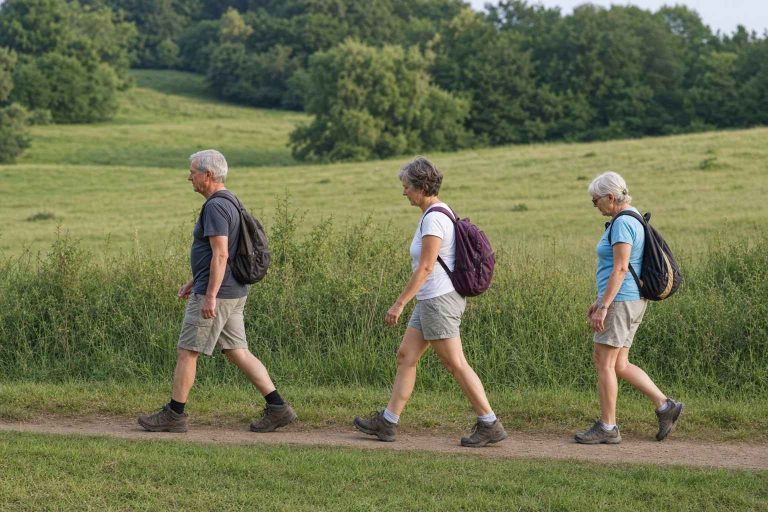
Walk the first ten minutes slower than the trail asks
The most useful warm up move is not a stretch at all.
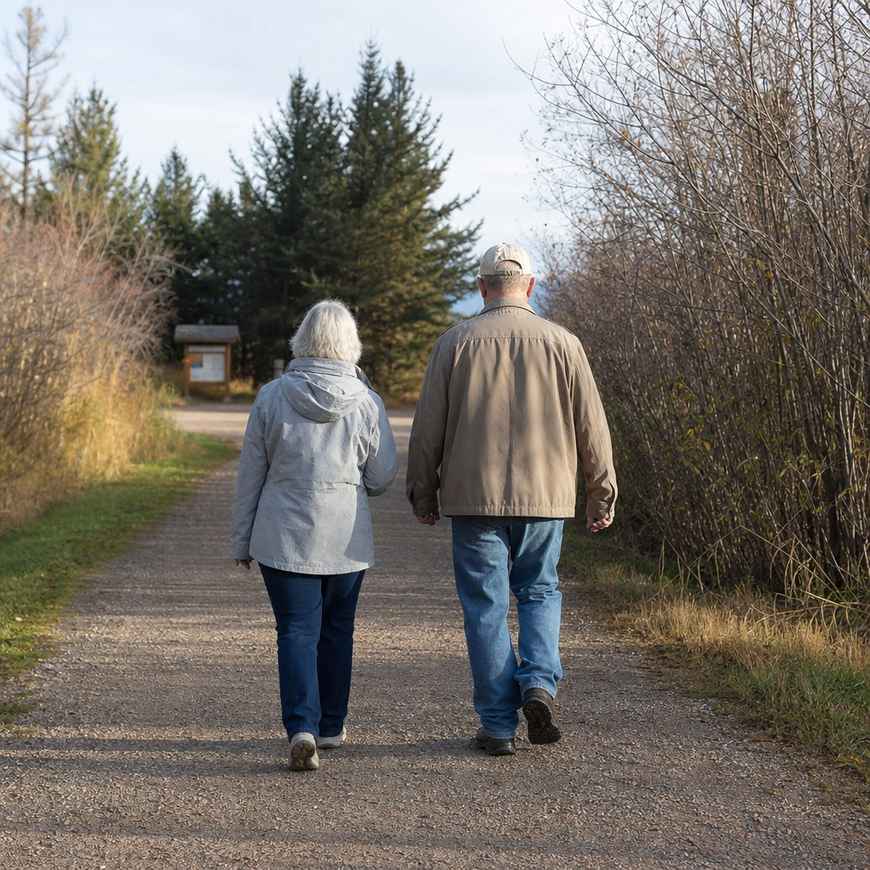
It is simply walking the first ten minutes slower than feels necessary.
Slow is the entire point of the first ten minutes.
An easy grade works. So does a flat approach path, or even the walk from the parking lot to the trailhead sign.
All of it counts, as long as the pace stays easy.
This is also when you start managing water for the whole day, not partway through it.
Drink one liter of water per two hours of hiking, on schedule not when thirsty. Waiting until you notice thirst means you are already behind.
Slow is the entire point of the first ten minutes.
Three moves that prepare hips, calves, and ankles
Beyond that slow first stretch of trail, three simple movements cover the joints that do the most work on a hike.
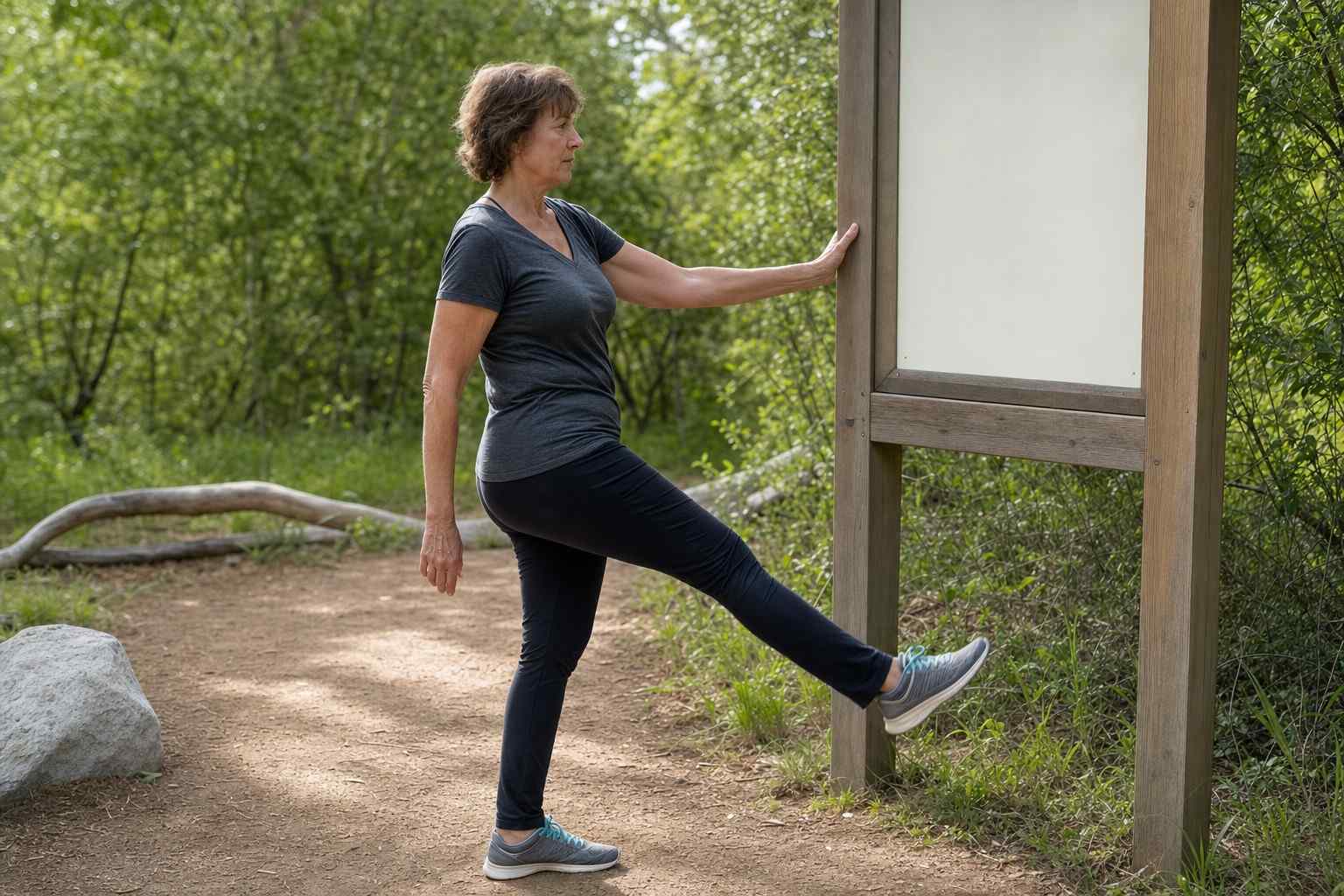
- Leg swings. Hold onto something stable, like a trailhead sign post or a low rail. Swing one leg gently forward and back, then side to side. Ten to twelve swings per leg loosens the hip joint.
- Calf raises. Rise onto your toes, then lower back down, slow and controlled, for about fifteen reps. Calves absorb much of the shock on uneven ground.
- Ankle circles. Lift one foot slightly off the ground and rotate the ankle in both directions. Ten circles each way wakes up a joint that takes a beating on rocky trail.
None of these need a mat, a class, or special clothing.
The whole sequence takes about five minutes, done right at the trailhead.
What you can skip
Skip anything that asks you to hold a stretch for thirty seconds while your muscles are still cold:
- Long, held stretches past a gentle reach.
- Deep lunges or full range holds before your legs have warmed up.
- Stretching a joint that already hurts. That is a signal to shorten the hike, not a stretch to push through.
Turning back early because something feels off is not a loss.
Turn around at 50% energy, not when you’re tired. The return hike requires equal effort. That principle starts applying from the first step, not just the halfway point.
None of this replaces guidance from your own doctor. That matters especially if you manage a joint condition, take medication that affects your heart rate, or are easing back into hiking after time off.
Pace and gear are the rest of the story. Both feed into what else matters about starting to hike after 50.
The five minute warm up, recapped
Put together, the whole routine takes less time than tying your boots.
- Walk the first ten minutes slower than feels necessary.
- Ten to twelve leg swings per leg, holding onto something stable.
- Fifteen slow, controlled calf raises.
- Ten ankle circles in each direction, per foot.
- Drink water on schedule, not when you notice you’re thirsty.
That five minutes is the whole difference between muscles that are ready for the trail and muscles that are just along for the ride.