Most beginners pick a trail by distance. They search “3-mile beginner hike” and book the first result that looks manageable.
Distance is the last thing you should look at, not the first.
This article covers four things to check before choosing a trail, evaluated in order. It’s written specifically for adults returning to activity after years away, or starting fresh after 50.
Not a generic beginner guide.
If you want the physiological context behind why trail selection works differently at this life stage, Starting Hiking After 50: What’s Actually Realistic covers what your body is actually doing on those first hikes.
Check these four things first: elevation gain, surface type, time estimate, and facilities.
In that order.
Start with Elevation Gain, Not Distance
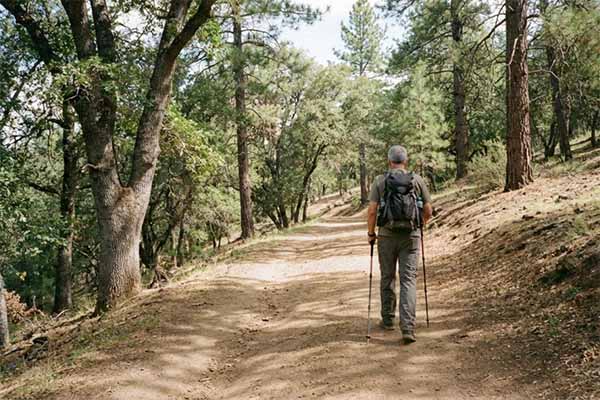
Distance tells you how far your feet travel. Elevation gain tells you how hard your cardiovascular system works.
These are not the same measurement.
A flat 4-mile trail is manageable for most people on their first hike. A 2-mile trail climbing 600 feet will surprise you, and not in a good way.
The surprise isn’t leg fatigue.
It’s your heart and lungs responding to sustained uphill effort in a way flat walking never requires.
Most new hikers underestimate this. They train by walking their neighborhood, which is almost entirely flat, and assume hiking distance translates directly.
It doesn’t.
According to the Wilderness Medicine Society, cardiovascular response to elevation gain is the primary factor in hiker exhaustion for deconditioned adults, not total mileage.
Start with trails under 300 feet of elevation gain for your first five hikes.
That number gives your cardiovascular system time to adapt before you add serious climbing. It also keeps the first five hikes honest, regardless of how fit you feel on flat ground.
Many adults who walk regularly are genuinely surprised by how different sustained climbing feels.
Walking and hiking use overlapping muscle groups but place entirely different demands on your heart and lungs.
Finding elevation data is straightforward. AllTrails lists elevation gain on every trail page, directly below the distance and difficulty rating. Park websites usually include it in trail descriptions.
If neither source lists it, call the ranger station.
A trail without elevation data is a trail worth skipping until you have more experience reading your own signals.
When you pull up a trail listing, read the elevation number before the distance. How to Read Hiking Trail Difficulty Ratings explains how trail ratings are calculated and why the same difficulty label can mean very different things depending on the trail system.
Surface Type Tells You Two Things
Surface type predicts two things: your realistic pace and your joint stress.
Both matter before you commit to a trail.
Paved trails, boardwalks, and packed gravel support a pace of about 2.0 mph for most adults over 50. Natural surfaces, including dirt, roots, and rocks, slow you to around 1.5 mph.
That gap compounds over distance.
A 4-mile natural trail takes roughly 30 minutes longer than a 4-mile paved trail, before elevation is even factored in.
Surface type also determines ankle and knee load. The American Hiking Society reports that uneven natural surfaces are responsible for the majority of ankle sprains and falls among recreational hikers, with descent on loose terrain as the highest-risk scenario.
Paved and packed surfaces reduce that variable significantly.
The honest trade-off: paved trails offer stable footing and predictable pace. Natural surfaces offer better scenery and the experience of actual trail walking.
Neither is wrong.
But natural surfaces are not where new hikers should develop trail-reading skills.
Learn your pace and your signals on stable ground first.
Your first hike should be 2-4 miles round trip, regardless of elevation gain.
Now Calculate Your Distance
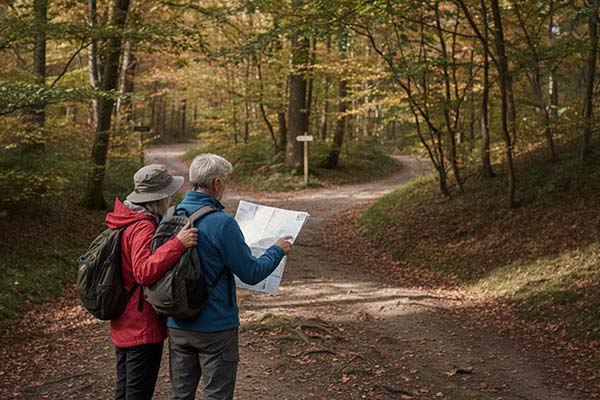
Once you know the elevation gain and surface type, distance becomes a meaningful number.
Before that, it’s just a length with no context.
Here’s how to estimate your time before you go. Take a 3-mile dirt trail with 200 feet of elevation gain.
At 1.5 mph on natural surface, 3 miles takes 2 hours. Add 0.2 hours for the 200 feet of gain (1 hour per 1,000 feet).
Total: 2 hours 15 minutes.
Run this estimate on any trail before you commit. It tells you whether the trail fits your available time and helps you plan your turnaround point honestly.
Turn around at 50% energy, not when you’re tired. The return hike requires equal effort.
This is the calculation most new hikers skip. They feel good at the halfway point and keep going.
The return trip, often on tired legs with descent added, is where most mistakes happen.
Facilities Are Not Optional
Restrooms, parking logistics, and cell signal are safety considerations.
Not comfort preferences.
This matters specifically for the adults this guide is written for. Solo hikers, those managing health conditions, and anyone far from immediate help need to know what’s available before they’re on the trail.
An hour into a hike is not the moment to discover there are no facilities and no signal.
According to the National Park Service, inadequate trip planning, including failure to confirm facilities and access points, is among the most common factors in preventable hiking incidents.
Find this data before you go. AllTrails listings include restroom and parking notes on most entries. Park websites carry more detail.
For trails with limited information, call the ranger station directly.
If you can’t get a straight answer on facilities, choose a different trail.
The information exists for popular beginner trails.
Its absence is itself useful data.
Check All Four Before You Book
Four checks, evaluated in order: elevation gain, surface type, time estimate, facilities.
Distance is the last number you look at, not the first.
That sequence changes which trails make the list and which ones don’t. A 5-mile paved trail with 150 feet of gain and parking at the trailhead is a better first hike than a 2-mile dirt trail with 400 feet of gain and no restrooms.
Distance alone would point you toward the shorter trail.
These four checks point you toward the safer one.
The trail that fits the criteria gets you home confident. That confidence is what brings you back.
If you want to see this applied to real options, Best Beginner Hiking Trails in California evaluates trails across the state using exactly these criteria.
Distance is always the last column worth reading.